The Bathroom Is the Problem, Not Your Blow-Dry: A Stylist’s Guide to Closing the Salon Gap
Every week, someone sits in my chair, catches their reflection in the mirror and says the same thing: “It never looks like this at home.” They say it almost apologetically, as if their bathroom has personally let them down. And in a way, it has.
The salon mirror effect is real, but it is not magic. It is a combination of good lighting, a sensible chair angle, clean sectioning and products applied in the right order. None of that is impossible to copy at home. You just need to know what you are copying.
It Is Not Vanity — It Is Optics
Salon lighting is designed to flatter hair. It is usually diffused, comes from more than one direction and does not drill a hard spotlight into the crown of your head. Your bathroom, by contrast, may have a single overhead bulb, a downlight that casts shadows under your roots and a mirror that fogs up the moment someone runs a hot shower.
That does not mean your hair is worse at home. It means you are seeing it under less forgiving conditions. A harsh downlight will make a perfectly healthy blow-dry look flat at the root and fuzzy at the ends. Add steam and a slightly smeary mirror and you have got a convincing case for the salon chair being a confidence trick.
It is not. It is just better staging.
The Chair Does Half the Work
Think about how you sit in the salon. The chair is reclined, your head is tipped back and your hair falls naturally away from the scalp. I stand behind you, so I can work with gravity rather than against it. The dryer points down the hair shaft, the tension is consistent and my arms are not contorted around a mirror.
At home, you are upright, elbows at ear level, trying to see the back of your head in a mirror while aiming a dryer at it. That is not a fair test of your technique. It is a test of your flexibility.
Try this: sit on a dining chair rather than standing at the bathroom mirror. Put a mirror in front of you at eye level, or use a wardrobe mirror with a socket nearby. If your only socket is by the door, move the mirror — not the dryer. An extension lead is cheaper than a professional blow-dry and far less stressful than stretching a cable across a wet floor.
Sectioning Is Not a Salon Secret
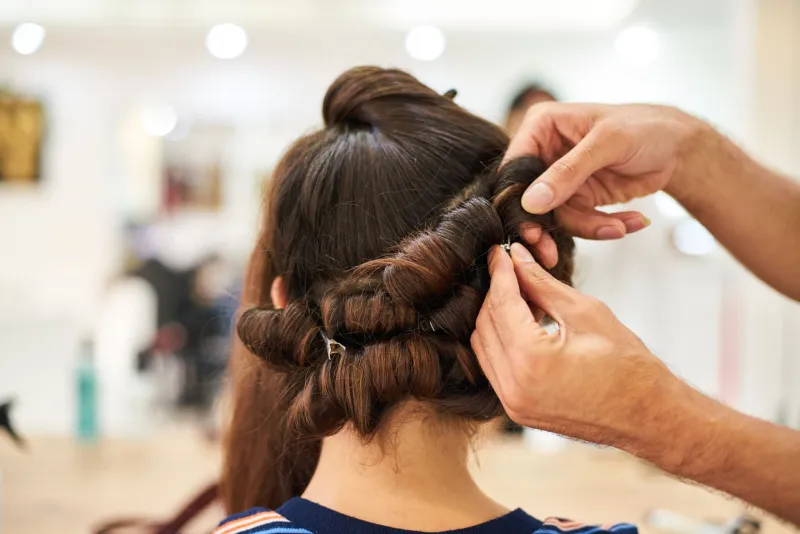
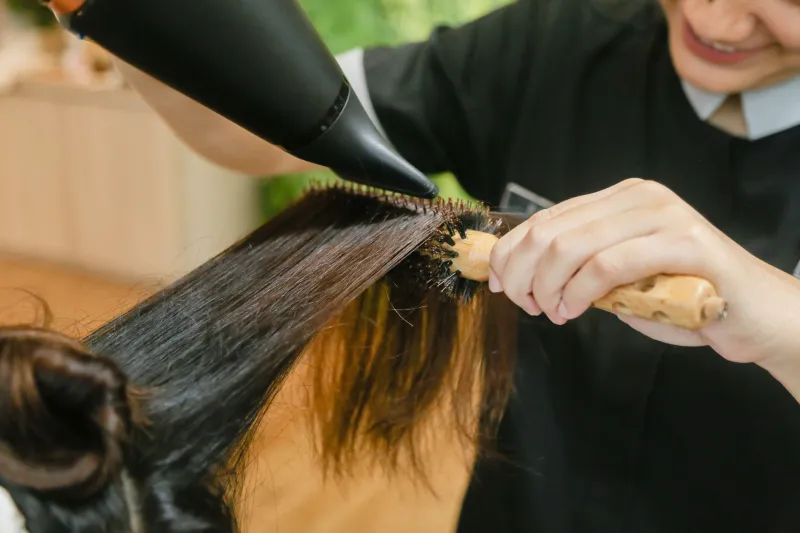
When I blow-dry, I work in clean sections. Roots first, then mid-lengths, then ends. Each section gets dried before I move on. At home, most people aim the dryer at the whole head and hope for the best. That is why the top looks smooth and the underneath is still damp an hour later.
You do not need pin-thin sections. Four is enough: two at the front, two at the back. Clip the rest out of the way. Dry the back first because it takes longest and you will not be able to see it later. Use the nozzle. Keep the dryer moving. And do not start with a round brush until the hair is about eighty per cent dry — otherwise you are just cooking the outside and leaving the inside wet.
Product Layering: Less, Earlier, Smaller
Salon products often look like more than they are because they are layered in small amounts, early. Heat protectant goes on damp hair before the dryer. Root lift goes at the scalp, not through the ends. Serum goes on the last few inches only. Finishing spray goes on at the end, from a distance, in a light mist.
At home, we tend to do the opposite: a heavy oil at the roots, a spray held too close, a serum worked through the whole head. Then we wonder why the blow-dry is limp by lunchtime. Try a two-pump rule for oils and serums. Keep root products at the root. If you can feel the product in your hair when it is dry, you have used too much.
Your Bathroom Is Working Against You
Steam is the enemy of a smooth finish. If you shower after you blow-dry, you are essentially asking your hair to re-curl in a sauna. Shower first, crack a window, wipe the mirror and give the room five minutes to clear. If your bathroom has no window, leave the door open and put the extractor fan on before you start.
Also, check your mirror height. If you are looking down at your reflection, you will tilt your head forward and dry the hair in the wrong direction. Raise the mirror or lower your chair. Small adjustments make a surprising difference to how the finished blow-dry sits.
The At-Home Reset Checklist
- Shower first, ventilate the room and wipe the mirror dry.
- Set up properly: mirror at eye level, extension lead if needed, clips, comb, nozzle on the dryer.
- Towel-dry to about fifty per cent — not dripping, not damp.
- Section into four and clip the rest away.
- Apply heat protectant, root lift at the scalp and a small amount of serum to the ends.
- Rough-dry the roots until the hair is eighty per cent dry.
- Finish section by section with tension and a cool shot at the end of each section.
- Use a light finishing mist from arm’s length and do not touch the hair until it has cooled.
- Do a final check by a window in daylight, not under the bathroom spotlights.
That last step matters more than people think. Bathroom lighting can make a good blow-dry look ordinary and an ordinary one look worse. Daylight is the honest mirror.
The Kindest Thing You Can Do
If your hair still falls flat after all that, it is not a failure. It may simply be that your cut and your routine are not on speaking terms. A good stylist will tell you that. Bring your usual products to your next appointment, or ask for a quick lesson in the chair. The salon finish is not a secret — it is a sequence. Once you know the sequence, you can take it home with you.