All-Night, Not All-Tight: Salon Party Hair That Holds Without the Headache
There’s a moment at every Christmas do when the room shifts. The prosecco is warm, the playlist has hit its second wind, and someone’s coat is on the floor. That’s usually when the first hand goes up to the head. A pin gets pushed back in. Then another. By the time the taxi is doing its third loop of the postcode, the updo that looked immaculate at 7pm has become a scalp ache with a side of regret.
From behind the chair, the tell is always the same. It isn’t that the style was ugly. It’s that it was built like a decoration rather than a structure. Party hair has to hold shape, weight and movement for hours. If the tension is in the wrong place, the whole thing starts to pull — and your scalp keeps the receipts.
Why a beautiful updo can turn on you by 10pm
Most painful updos aren’t caused by one terrible pin. They’re caused by concentration. Too much hair dragged to one anchor point. Too many pins crowded into the same square centimetre. Too much tension at the hairline because that’s the easiest place to get a clean finish. Add a warm room, a bit of dancing and a wool coat, and the hair expands and shifts while the pins stay exactly where they were put.
There’s also the weight issue. A low chignon on thick hair can be surprisingly heavy. If that weight is suspended from a few hidden pins, those pins are doing the work of a small bridge. Fine hair has the opposite problem: it’s light, but it slips, so stylists are tempted to pull tighter to compensate. Neither approach is comfortable by the end of the night.
A good party updo is a tiny suspension system. The aim is to spread the load, keep the hairline soft and make the pins grip hair rather than scalp.
The chair is where comfort gets designed
Before a single pin goes in, a stylist should be thinking about the shape of your head, the density of your hair, your scalp sensitivity and what you’re actually doing that night. Are you standing at a bar? Dancing? Wearing a hat? Taking a coat on and off? All of that changes how the style needs to be anchored.
This is also the point to speak up. If your scalp is sensitive, say so. If you’ve had a headache from an updo before, say that too. A stylist can build around it, but only if they know. The best salon conversations about party hair aren’t about the picture on your phone. They’re about where the weight will sit and how the style will come down.
Pin placement: grab hair, not scalp
Bobby pins should slide in with the ridged side down, picking up a small section of hair and the base underneath. They shouldn’t be forced flat against the scalp. If a pin needs to be shoved, it’s in the wrong place. That’s the rule I’d put on the wall.
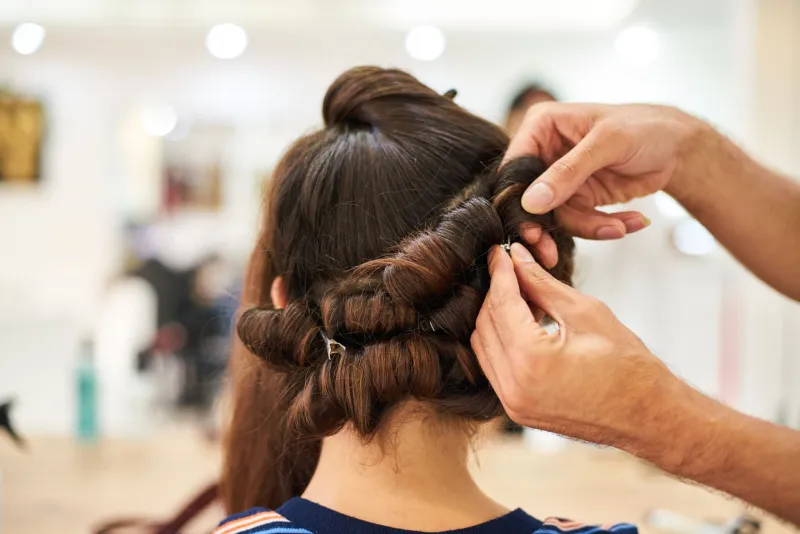
Good pin placement is scattered rather than clustered. Criss-cross pins at an anchor point give more grip than a neat little row. U-pins can straddle a twist or a roll without digging in. French pins can hold a chignon with surprisingly few contact points if the hair has been dressed properly first. The visible finish might look smooth and simple, but underneath it should be a map of small, balanced anchors — not one poor pin doing overtime.
For fine hair, the temptation is to over-pin. Often the better move is more texture and smaller sections, so each pin has something to grip. For thick hair, the temptation is to use bigger sections and more force. Often the better move is to split the hair into two or three working sections and join them at the end.
Tension distribution: make several anchors do the work
Think of the head in zones: hairline, crown, sides and nape. A comfortable updo usually has more than one anchor. Soft elastics can create a base, then the shape gets pinned to that base rather than dragged across the head to a single point. If all the hair is pulled towards one spot, that spot will throb. If the weight is shared, the style can still be secure without feeling tight.
The hairline is not a load-bearing wall. It’s the most sensitive part of the head for most clients, and it’s also where tension shows first. A stylist can keep the front soft and build the structure further back, then blend the two. That’s how you get a polished finish without the 10pm wince.
Fine hair: grip without grit
Fine hair needs texture, not brute force. A light root lift, a little dry texture spray and some gentle backcombing at the base can give pins something to hold. Small sections, crossed pins and a bit of padding can create shape without adding weight. Heavy oils and creams are usually the enemy here — they make the hair slippery and the pins less effective.
If your hair is very fine, ask for a style that works with your natural grip rather than against it. A soft twisted low bun, a pinned half-up or a textured chignon will often be kinder than a sleek, tight ballet bun. And if you want height, ask for it to be built on a base rather than backcombed into a cloud that collapses by pudding.
Thick hair: spread the weight
Thick hair needs respect. It’s lovely to work with, but it’s heavy. A stylist should split it into sections, use soft ties to create separate bases and then pin those bases together. A braided or twisted foundation can help distribute weight around the head. Larger U-pins and French pins often work better than a fistful of bobby pins, because they support the shape rather than stab at it.
If you’re having a big updo for a black-tie event, ask how the weight will be balanced. A style that sits low at the nape needs different anchoring from one that sits high on the crown. Neither should rely on one elastic and a prayer.
Questions to ask before the first pin goes in
You don’t need to be an expert to ask good questions. You just need to be clear about what you want to feel like at midnight.
- “Where will the weight sit, and can we spread it across more than one anchor?”
- “Can we keep the hairline softer and build the shape further back?”
- “Which pins will be close to my scalp, and can you show me how they’re placed?”
- “Will this hold if I’m dancing, putting on a coat or taking a hat on and off?”
- “Can we do a head-turn test before I leave?”
- “What’s the takedown plan — how many pins, and how should I remove them?”
That last one matters more than people think. A good updo should come down without a fight. Pins should be removed one at a time, with a hand supporting the style so it doesn’t drop and drag. Then a gentle scalp massage and a brush through is the reset. If you’ve had a painful updo before, book a trial or ask for a looser foundation. There’s no medal for enduring a style that hurts.
The 30-second test
Before you leave the salon, do the test. Turn your head left and right. Tilt it back. Pretend to put on a coat. If you can feel a sharp pull at one point, say so. A stylist would much rather adjust a pin in the chair than have you spend the night trying to discretely massage your own scalp in the loos.
Party hair should look considered, not punishing. The best compliment isn’t “that must have taken ages.” It’s “I forgot I was wearing it.” That’s the standard we aim for behind the chair — and it’s the one worth asking for.