The Consultation Starts Before You Sit Down: Five Things Your Hair Tells a Stylist
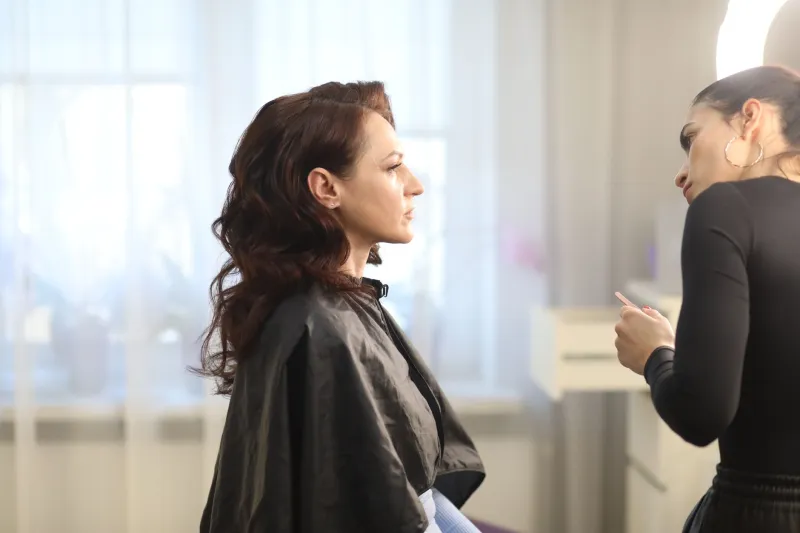
You sit down, the cape goes on, and someone asks how your hair has been. It sounds like small talk. It is not. By the time your stylist has run their hands through your mid-lengths and looked at your parting in the mirror, they have already clocked a fair amount — and the reason they ask so many questions is that most of it is fixable once it is named.
None of this is about catching you out. A good consultation is the difference between a cut that looks great for three days and one that still works six weeks later. So here are the five things we notice most often, and what we would actually do about each.
1. The shed that arrives three months late
Hair loss has a memory. A period of illness, a bereavement, a crash diet, a difficult few months at work, surgery, or a new baby all tend to show up in the hairline and the ponytail roughly two to four months after the event, not the week it happened. Clients often cannot connect the two, then are baffled when the bathroom floor looks like a crime scene in February.
What we do in the chair: resist the urge to cut it all off in a panic, because short hair sheds in shorter, more visible pieces. We lighten the weight through the ends, avoid blunt lines that show thinness, and take it gentler on heat for a while.
What we would say out loud: if shedding is heavy or lasting longer than a few months, that is a GP conversation, not a salon one. Bloods for ferritin, thyroid function and vitamin D are a sensible starting point — especially in a UK winter, when most of us are running low on the last one.
2. The ponytail line
Push your hair back and there it is: a slightly thinner patch or a little crop of broken hairs at the same spot on the hairline, every time. That is mechanical damage, and it is almost always the same ponytail in the same place, or a topknot slept in overnight (which linen pillowcases and a busy week make very tempting).
What we do: soften the front, suggest a fringe or face-framing layers so you are not relying on scraping everything back, and give the honest speech about soft ties. Rotate where you place the band. Never sleep in it. Silk scrunchies are not a gimmick if you are someone who genuinely lives in a bun.
3. Dry ends with an oily root
This is the classic UK winter combination: cold, damp air outside, dry central heating inside, and a scalp producing oil to compensate. The instinct is to wash more, which strips the scalp further, so it produces more oil, and the cycle continues.
What we do: talk about washing the scalp rather than the hair, keeping conditioner from the ears down, and clarifying once a fortnight if you use a lot of styling product. A weekly mask on the ends only costs a fiver and does more than most things on the shelf.
Little signs we pick up on: a crunchy feel near the roots means build-up, not dryness. If the ends feel rough but the roots feel waxy, you probably need to clarify rather than condition.
4. The snap test
Take a shed strand and stretch it. Healthy hair stretches a little and bounces back. Hair that snaps immediately, or stretches like chewing gum and does not return, is telling you something — usually about heat, bleach or both.
What we notice: the telltale few centimetres of white dots along the ends, a slightly frizzy halo that will not smooth, and a client who says the straighteners only go on for a minute. We hear you. But 230°C for a minute every morning will always show up eventually.
What we do: take off the damaged ends (there is no product that repairs a split), drop the iron to 180, insist on heat protectant, and add a bond-building treatment if there is bleach in the history. It is not a quick fix, but it is a real one.
5. Hormonal handwriting
Hormones leave very readable clues. The wispy regrowth fringe that appears around six to nine months after a baby. A parting that has slowly widened through perimenopause. A texture that has gone from sleek to wiry in a couple of years. Thinning at the temples alongside other symptoms. A change in how your hair takes colour, or suddenly going brassy far faster than before.
We are stylists, not doctors, and we will never diagnose from the chair. But we will say something, because a lot of clients assume it is their imagination. It usually is not — and knowing that is the first step towards a GP appointment or a sensible plan.
What we do in the meantime: work with the hair you have rather than the hair you had. That might mean a shorter, lighter shape, a soft root shadow rather than a hard line of colour, or a scalp-friendly routine.
Why we ask so many questions
Every question in a consultation — how often do you wash it, what do you use, do you sleep with it wet, when was your last colour — is us trying to build a picture of the next six weeks. A beautiful cut that needs twenty minutes of styling every morning is a bad cut if you have seven minutes before the school run.
So be honest about the box dye you used in October, the straighteners, the fact that you never use conditioner, the holiday sun. None of it is a confession. All of it helps.
Getting more out of the chair
- Bring two or three photographs of hair you actually like, on someone with a similar texture to yours.
- Say what you do not want, not just what you do. It closes the gap faster.
- Mention any big dates in the next couple of months — a wedding, a party, a holiday — so the shape can be planned around them.
- Ask what to use and how much of it, then write it down. Most of us will happily scribble it on a card.
- If you have a lot going on, book a consultation appointment rather than a cut. Fifteen minutes without scissors is genuinely useful.
Your hair is a record of the last six months — the stress, the heating, the bleach, the good intentions. Once we have read it together, we can do something about it. That is the whole point of the appointment.