Sleeping on It: Why Foam Rollers Are Party Season’s Quiet Overachiever
Party season has a way of making ordinary hair routines feel unreasonable. One Christmas do, one late office night, one Sunday lunch that turns into dinner, and suddenly you’re reaching for the straighteners every morning because you can’t face starting from scratch. That’s exactly where the overnight wet-set earns its place. It’s not a retro stunt or a Pinterest project. Done properly, it’s a salon technique that gives you bend, volume and polish while you sleep — and it asks far less of your hair than a daily pass with hot tools.
What an overnight wet-set actually is
A wet-set means hair is washed, towel-dried, sectioned and wrapped around rollers or pin curls while it’s still damp. The hair dries in that shape. You’re not baking a curl in with heat; you’re using tension, product and time. In the chair, we’d call this a roller set or a wet-set. At home, it’s foam rollers, clips and a bit of patience before bed.
The result is different from a wand curl. A tong gives you a defined, slightly more polished curl that drops through the day. A wet-set gives a softer, more integrated bend — the kind that looks like your hair has simply decided to behave. It’s also brilliant for root lift, especially around the crown and parting, because the hair is lifted as it dries rather than pressed flat.
The salon version: what to ask for
Don’t ask for a ‘big bouncy blow-dry’ and hope for the best. Ask for a wet-set, roller set or a set-and-brush-out, and be clear about the finish you want. Soft waves? Ask for larger rollers and a loose brush-out. More volume at the root? Smaller rollers near the crown, larger through the mid-lengths and ends. A smooth, rounded bob? Pin curls or medium rollers, brushed into shape rather than left springy.
This is also a consultation conversation, not a drive-thru request. Your stylist needs to know how much time you have in the morning, whether you’re happy leaving with hair that isn’t fully dry, and whether you’ll be sleeping on the set or sitting under a dryer. If you’re booking before a big event, say so. A wet-set is a plan, and timing matters.
Sectioning and tension: the bit people skip
Most disappointing home sets fail in the sectioning, not the product. Hair needs to be sectioned smaller than you think. If the section is too wide for the roller, the hair won’t dry evenly and the bend will collapse or go frizzy at the ends. Neat sections also mean less chance of a kink where you clipped the roller in.
Tension is the other make-or-break. You want the hair wrapped smoothly and firmly — enough that the roller holds, not so tight that your scalp is complaining before you’ve even got into bed. Ends should be wrapped with a little end paper or smoothed between your fingers so they don’t buckle. A crunched end dries into a crunched set. Roll under for a smooth, classic finish; roll away from the face for more lift and a more modern bend.
Product rules for a soft result
This is where people overdo it. A wet-set doesn’t need a heavy cream, an oil or three serums. Too much product and the hair dries sticky, then brushes out into a crunchy cloud. Start with clean hair and keep conditioner away from the roots. A lightweight mousse or a proper setting lotion is usually enough. A small amount of leave-in on the ends is fine if your hair is dry or coloured; just don’t coat the mid-lengths before setting.
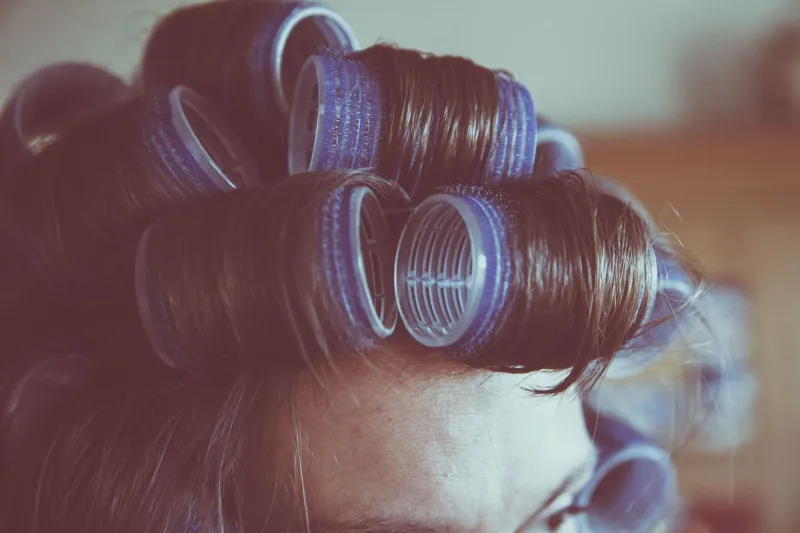
Foam rollers are the easiest place to start. Velcro rollers can grip too hard on damp hair and leave marks, so save those for dry second-day root lift. If you’re using pin curls, keep them smooth and flat to the head, and don’t twist the hair as you wrap. Twisting creates a sharper curl; a wet-set is usually about softness.
The British damp morning problem
The biggest enemy of an overnight set isn’t your pillow. It’s a damp November morning and a steamy bathroom. If the hair is still even slightly damp when you take the rollers out, the set will drop before you’ve found your keys. If you can, finish the drying before bed with a hood dryer or diffuser on a low setting. Hair that goes to bed properly dry holds the shape far better.
In the morning, don’t brush out a set in a bathroom that’s just hosted a hot shower. Let the room air, take the rollers out gently and give the hair a minute to settle. A light humidity shield or flexible hairspray can help once the hair is brushed, but don’t spray it into a damp set and expect miracles. And if it’s properly raining, keep the set loose and avoid flattening it under a tight hat until you’re actually outside.
Taking it out without wrecking it
Unroll slowly. Don’t pull the roller straight down the hair; unwrap it the way it went on. Shake the roots gently with your fingertips, then use a wide-tooth comb or your hands to blend the sections. If the bend is too tight, stretch it out with your palms rather than attacking it with a brush. Let it settle for five minutes before you decide it needs more product. Most sets look better after they’ve had a chance to relax.
Who it suits — and who should skip it
The overnight wet-set suits medium to long hair, especially fine to medium hair that wants volume and movement without daily heat. It’s lovely on coloured hair that needs a break from tongs, and it’s a smart option for anyone who can plan ahead the night before. A bob can work beautifully with pin curls, but it needs a stylist’s eye for placement.
Skip it if you have a very short crop, a sensitive scalp that won’t tolerate rollers, or hair that’s extremely resistant and coarse — that hair often needs more heat or a professional set with a hood dryer to hold. If you wear your natural curls and want definition, this isn’t a curl routine; it’s a smooth set. And if you want glassy, pin-straight hair, book the blow-dry instead. A wet-set is for softness, bounce and bend, not for fighting your texture into submission.
The honest trade-off is this: a wet-set takes planning. Fifteen minutes of sectioning and wrapping at night, a decent night’s sleep, and ten minutes of brushing out in the morning. That’s not zero effort. But compared with heat-styling every day through December, it’s a very good deal.